The history of the Dragon
A home computer from Wales, born in a toy company, sold by the tens of thousands in one winter, and ended in a factory in Spain. This is how it happened.
A toy company looks for a new direction
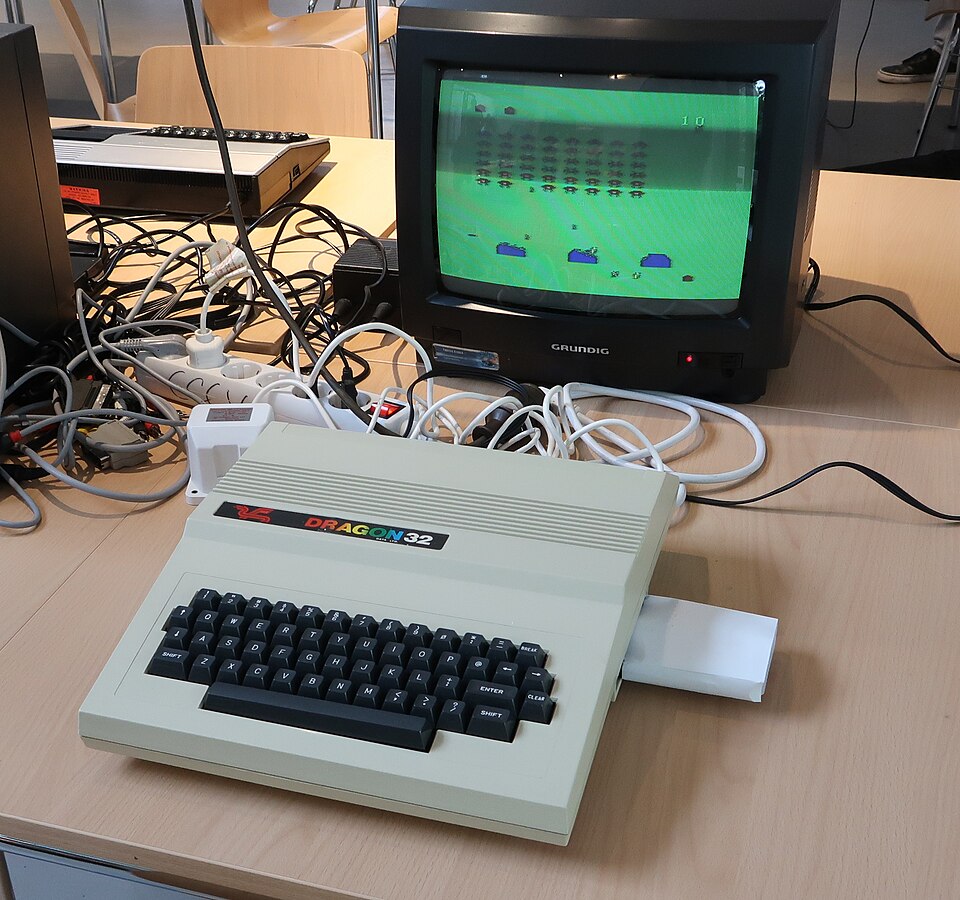
It all began at Mettoy, an old toy maker (the Corgi die-cast cars were theirs) that had moved to Swansea in Wales. In the early 1980s business was poor and it looked for something new. In 1981 a home-computer project started there, and in 1982 it became a subsidiary of its own: Dragon Data. The name suits Wales, whose flag carries the red dragon.
The company had no experience designing computers, so the design was done by a consultancy in Cambridge. The prototype was called Pippin, and it was ready in November 1981.
1982: the Dragon 32 reaches the shops
It was announced in June 1982 and reached the shops in August, for about £200. It was built on the same Motorola chips as Tandy's American Color Computer, so the two are very alike. But it is not a copy: the ROM differs, the BASIC command codes differ, and the Dragon has a printer port instead of a serial port.
How was it sold at the time? See the Dragon Data adverts.
- CPU
- Motorola 6809E, about 0.89 MHz
- Memory
- 32K (the original plan had less; the increase came at the last minute)
- Language
- Microsoft BASIC in a 16K ROM
- Display
- a home TV, 32×16 text and graphics up to 256×192
- Ports
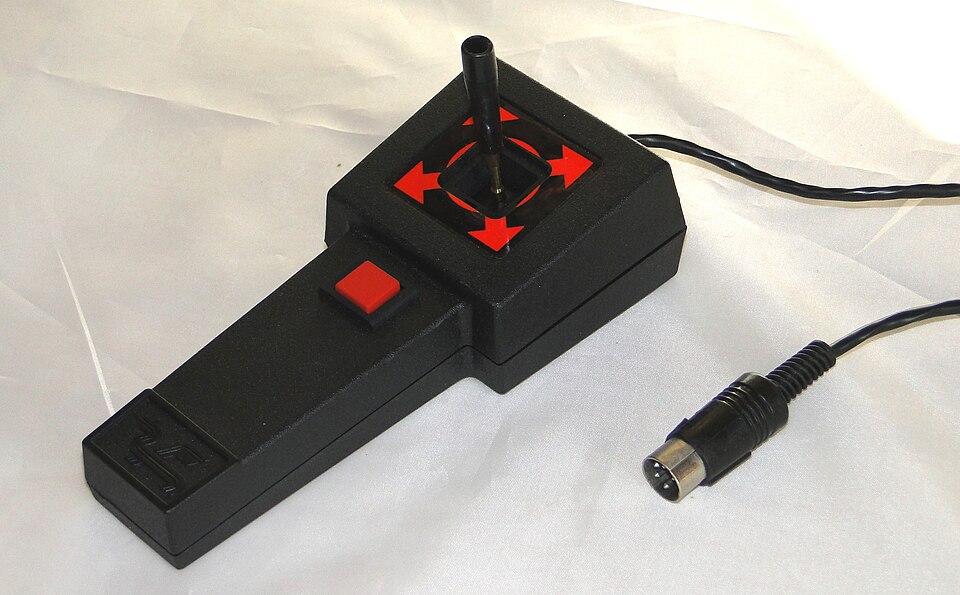
- cassette, cartridge, printer, two joysticks, TV and monitor
A good winter
By April 1983 about 40,000 had been sold, most of them before Christmas 1982. Part of the success came from the competition: the ZX Spectrum and BBC Micro were hard to get that winter. In March 1983 production moved to a bigger factory near Port Talbot, with production reported at about 5,000 machines a week. In the United States it was made and sold by Tano of New Orleans.
The Dragon 64 and the disk drive
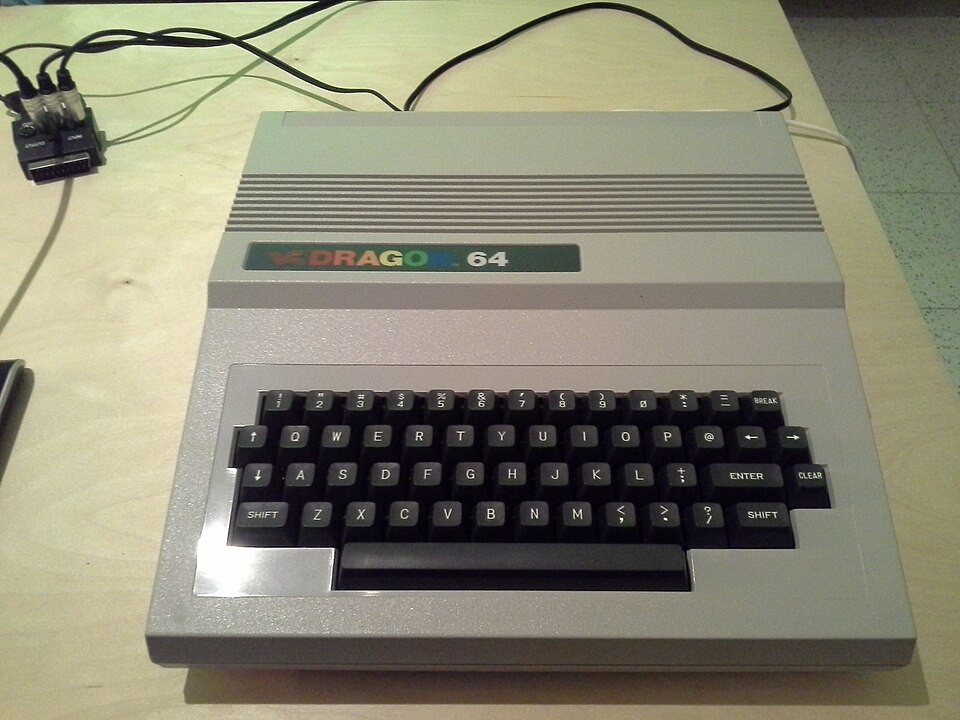
In 1983 came the Dragon 64: twice the memory, a serial port, a light-grey case, and support for the OS-9 operating system. In Britain it cost about £225, and Dragon 32 owners could upgrade. The disk drive arrived around the same time, with DragonDOS. Instead of waiting minutes for a tape, a program loaded in seconds.
What became of the company
Christmas 1983 was already hard; cheaper computers took the market. In September 1983 the chief executive was replaced by a manager on loan from GEC, which later invested in the company. It wasn't enough: in spring 1984 (sources differ on May or June) the company went into receivership. Tandy considered buying it, and in August 1984 walked away.
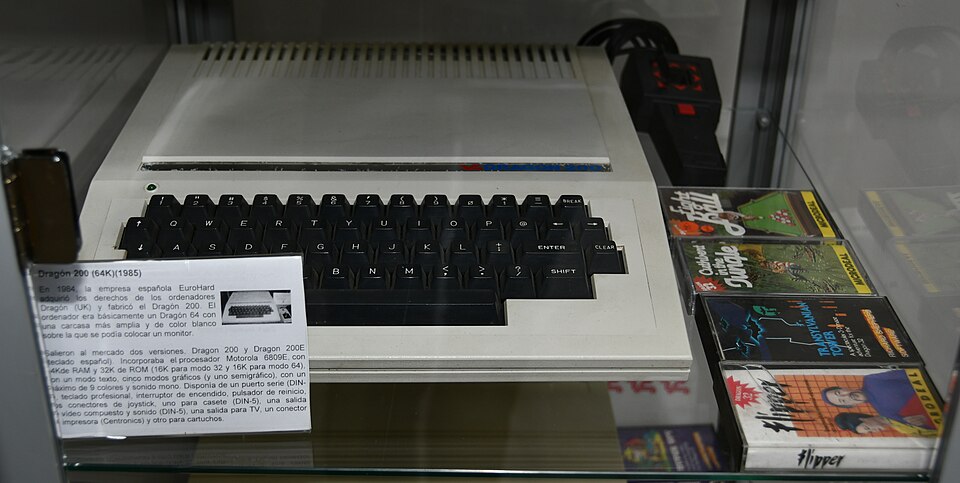
The buyer was a new Spanish company, Eurohard. It paid about £1 million and moved the whole factory to Spain, patents included. Production continued in a town near Cáceres in western Spain, with new models: the Dragon 200 and the Dragon 200-E, adapted for Spain (sources differ on which change came with which model). Within a year about 17,000 were sold there and about 20,000 more went to schools. But Eurohard didn't last either, and the factory closed in May 1987.
What people did with it
- Games. About 800 commercial games came out for the Dragon. The big publisher was Microdeal of Cornwall, with the Cuthbert series and more. There were also versions of Manic Miner and Jet Set Willy, the Spectrum hits. Microdeal stopped publishing for the Dragon only in January 1988.
- Learning to program. BASIC was there the moment you switched on. Kids typed in programs from magazines, line by line, and changed them.
- Its own magazine. Dragon User ran from 1983 to January 1989, long after the company closed.
- Schools and work. In Spain about 20,000 machines went to schools. With a disk drive and OS-9 it could be used for work too.
Games people remember
Some of the Dragon's well-known games (names only; the games themselves are not here):
- Cuthbert Goes Digging, Cuthbert Goes Walkabout, Cuthbert in the Mines (Microdeal, 1983–1984)
- Mr. Dig (Microdeal, 1984)
- Chuckie Egg (A&F Software)
- Manic Miner and Jet Set Willy (Software Projects)
- Hunchback (Ocean), Football Manager (Addictive Games)
- Airball and Tanglewood (Microdeal, 1987), among the last games released for it
Remember a game you loved? Tell us.
Today
There is still an active community of Dragon owners. Ciaran Anscomb's XRoar emulator recreates the machine faithfully, and this site runs on it too. And those who grew up on it, like me, are rebuilding it. The journey
Sources
Wikipedia (Dragon 32/64, Dragon Data), The Register (2012), Centre for Computing History, Binary Dinosaurs, Science Museum Group. Where sources disagree, we say so. Found a mistake? Tell us.
A hobbyist's tribute. Not affiliated with or endorsed by Dragon Data.